One Audio Engine on Every Device: What That Means for You
Software people like to say “same code everywhere.” For most of us, that sounds like a boast with little meaning. But in a music player, it has a very practical effect. This article explains what the “one engine” idea is, what you notice because of it, and where it stops.
What is an “audio engine”?
A music player is really two parts. One part is the outside that you see and touch: buttons, lists, colors and menus. The other part is the engine inside, which does the real work. It opens your file, turns the stored data back into sound, keeps track of the queue, reads the labels, applies the equalizer and keeps the timing right.
On many programs, those two parts are built separately for each system, so the Windows version and the Mac version are almost different programs that happen to share a name. They may handle files in slightly different ways, support different formats, or have bugs that appear on one system only.
What JahSing 3 does differently
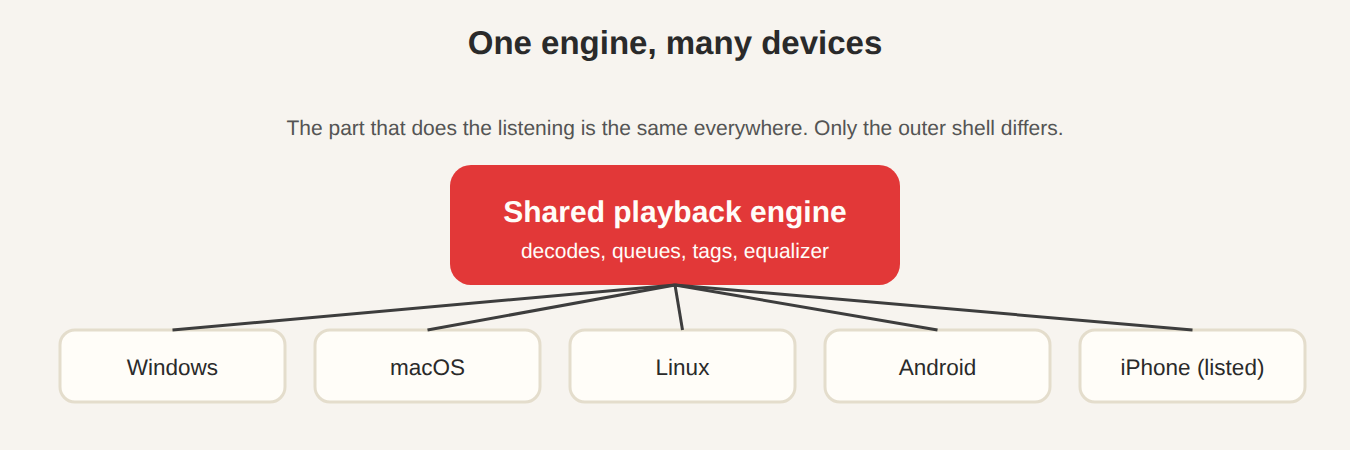
According to the Features page, JahSing 3 uses “a modern audio engine that decodes and plays on every platform: the same engine, byte-for-byte, on desktop and mobile.” The project’s migration notes explain the main pieces: the sound is decoded by a maintained library, the library of songs is kept in a small database, and the tag reading and writing is handled by one library for all file types. That core is written once and shared. What changes between devices is the outer layer, such as how the window is drawn and how the app talks to the system’s sound output.
Platforms are listed on the Features page as Windows 10 and 11, macOS 12 and newer, Linux (AppImage, deb and rpm) and iOS and Android. The v3.0.0 release notes list downloads for Windows, macOS, Linux and Android. The Android package is installed directly rather than from the Play Store.
What you notice in practice
1. The same files behave the same way
If a song plays on your desktop, it should play on the Android phone too, because the same code decodes it. That is a relief if you keep a library on a USB drive or sync folders yourself. You do not have to worry that one device will reject a file that another one accepts.
2. The same tags show up
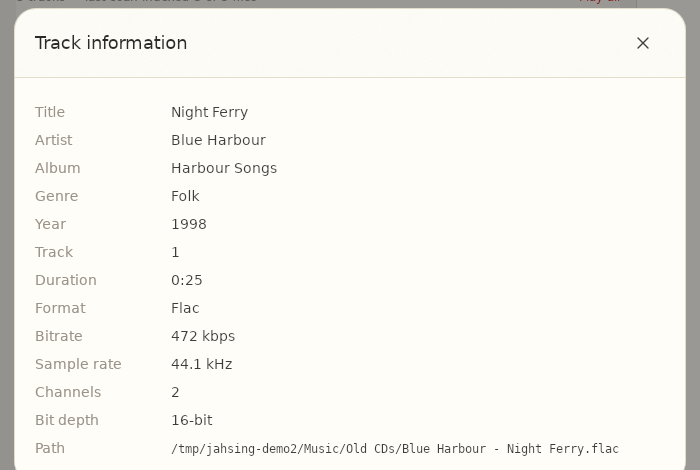
Reading labels from files is a surprisingly tricky job. Different file types store title, artist, album and cover art in different ways. With one shared tag library, a song’s details look the same on every device. A song that needed a tag repair on your laptop will show the repair on your phone as long as the edited file is the one being played.
3. The equalizer and balance work alike
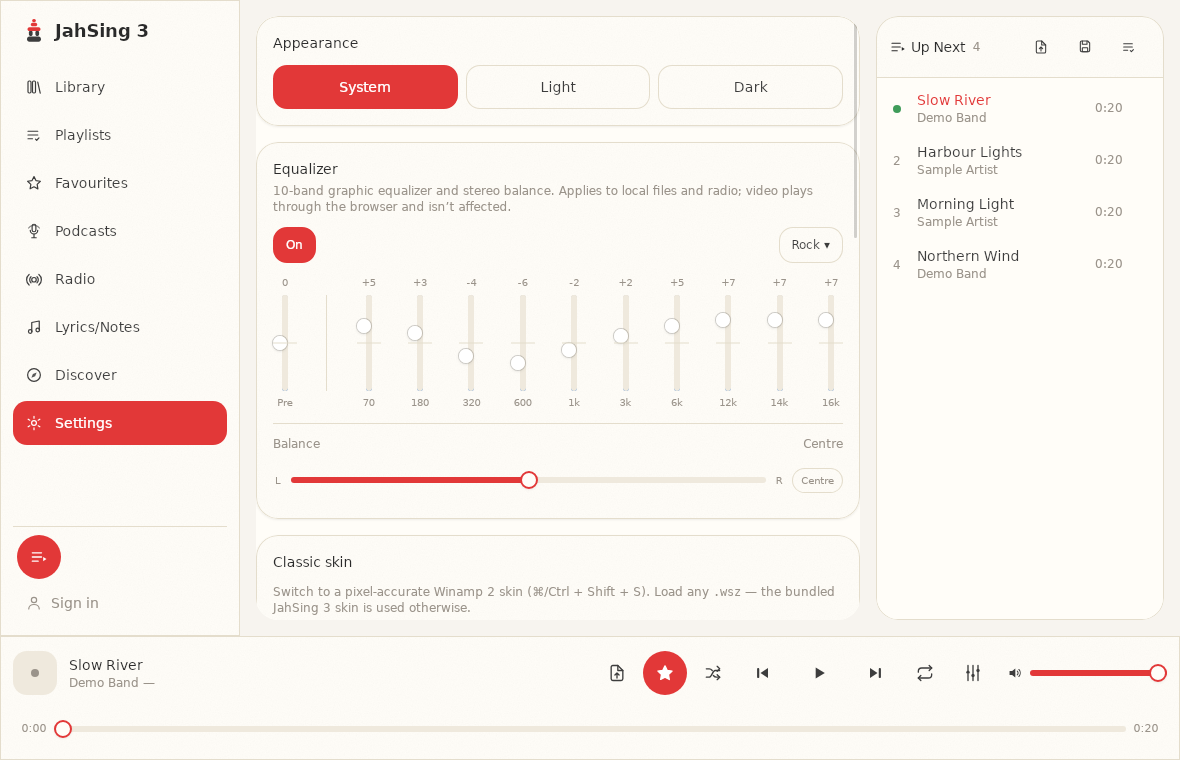
The 10-band equalizer, the preamp and the stereo balance are part of the shared core. A preset such as Rock moves the same sliders to the same values wherever you use it. The project’s notes say the balance setting carries over from track to track, in the style of Winamp.
4. Fixes reach everyone at once
When a problem is found in the engine and fixed, the fix applies to every version that uses it. With separate engines, a fix has to be written several times, which is slower and more error-prone.
Where the “same” stops
It would be misleading to say everything is identical. Some things naturally depend on the device:
- The look and feel. A phone screen is not a desktop window, so the layout differs.
- Where your music is. A phone has its own storage and permission rules for reaching files. The migration notes describe the mobile library source as a separate piece of work that plugs into the shared core.
- Video. The release notes say video on Linux depends on GStreamer codec packages that you install from your distribution. The pop-out video window and some playback details differ by system.
- Sound output. Each system has its own way of sending sound to speakers or headphones, and the app has to connect to it. Bluetooth, for example, is managed by the operating system.
- Not every platform ships at once. The features page lists iOS, but the first public release notes cover Windows, macOS, Linux and Android. Check the Downloads page for what is available today.
Why does this matter to you?
Most people never think about engines, and they should not have to. The benefit shows up as things that simply work: the same album plays the same way, in the same order, with the same details, whichever device you pick up. If you move between a desktop at home and a phone on the road, that consistency is the point.
It also supports JahSing’s local-first approach. A shared engine means your files and your library work on their own on every device, without needing a company server in the middle. The planned second phase includes optional ways to share your place across devices, but the project says the core player does not depend on it.
Try it yourself
Add a folder of music on one device, check that it plays, then try the same files on another. Open the Track information window for a few songs and compare. If something differs, that is worth reporting, because the whole idea is that it should not.
You can find the current versions on the Downloads page, and the planned features on About & Roadmap.
Sources: JahSing Features; JahSing About & Roadmap; the JahSing 3 v3.0.0 release notes at github.com/duanecato/jahsing3-releases.