The MP3 Player Years, 1998 to 2009: Where JahSing Fit In
If you were around in the late 1990s and 2000s, you may remember how fast the way we listened to music changed. In about ten years, music went from CDs in a rack, to files on a computer, to a small player in your pocket, to songs delivered over the internet. JahSing was born in the middle of this change. This article is a quick tour of the neighborhood it grew up in.
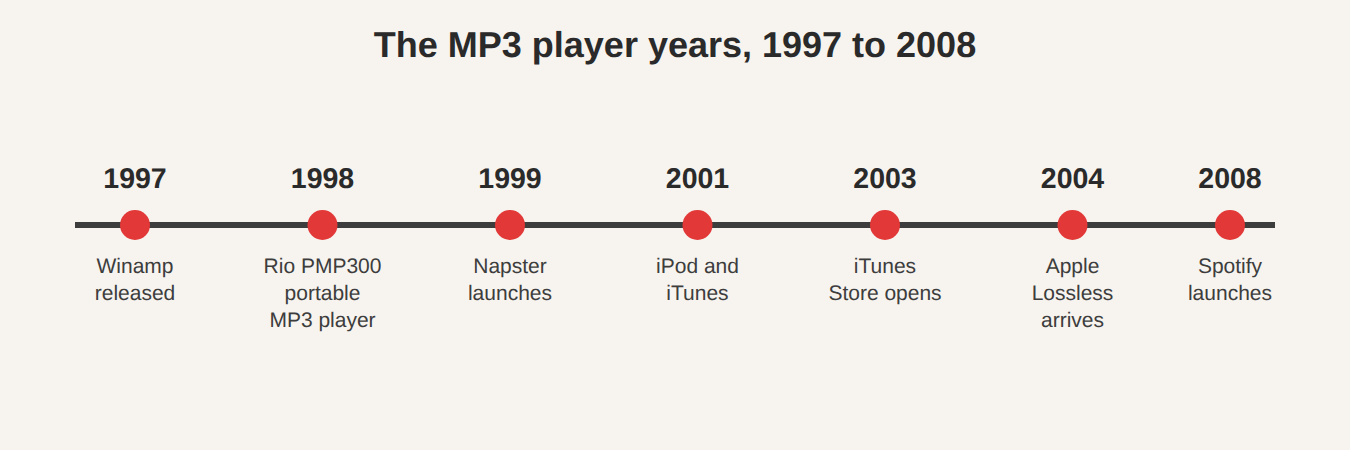
1997: Winamp sets the tone
The story of desktop music players in this era usually starts with Winamp. Its first version appeared on April 21, 1997, from two young programmers, Justin Frankel and Dmitry Boldyrev, who worked under the name Nullsoft. It started as a very simple freeware program for playing MP3 files, and by version 1.0 later that year it had a graphic equalizer and a playlist editor. Winamp was later sold to AOL in 1999 for around 80 million dollars, according to a history of the program.
What mattered most was the style. Winamp was small, quick to open and could be dressed up with downloadable “skins.” Many people who used it still remember the look. That is also why skin support turned up in so many later players, including JahSing 2 and JahSing 3. We cover that in our article on Winamp skins.
1998: music leaves the computer
In September 1998, a company called Diamond Multimedia introduced the Rio PMP300. It stored about 32 megabytes, which was enough for roughly a dozen songs at typical quality, and it was one of the first portable MP3 players that was a commercial success. It was not the very first; a Korean player called the MPMan had launched earlier that year. You can read more at this page about the Rio PMP300.
Pocket players needed a way to get songs onto them, and the answer was a program on your computer. That raised the importance of “music managers,” meaning programs that organized your collection and copied it to your device. This is the world Jahsee, the first version of what became JahSing, was born into in 1998. It was a playlist manager written in Java.
1999: Napster changes everything
On June 1, 1999, a program called Napster was released by Shawn Fanning and Sean Parker. It let users share files straight from their own computers, and by October of that year millions of songs were in circulation. Napster was shut down in the following years after legal action by the music industry, but its effect stayed. After Napster, people expected music to be easy to find and instantly available. Players that could handle large, mixed collections, with sensible searching and tagging, became much more important.
2000: JahSing 1
This is where JahSing steps in as a full player. JahSing 1 combined playing and playlist management in one program and, by the project’s own account, was the first MP3 player written fully in Java. For the next nine years it was updated alongside everything else in this story.
2001 to 2003: the iPod and iTunes
Apple released iTunes in January 2001, and the first iPod in October of the same year. In April 2003, the iTunes Store opened and sold songs for a fixed price each. For many people this made buying digital music feel normal and legal. It also meant people ended up with an ever larger mix of file types, so a player that could read many kinds of files was a good thing to be.
2004: better-quality files for ordinary people
In 2004 Apple added its lossless format to its software. A lossless file keeps all the detail from the CD, instead of throwing some away like MP3 does. The files are bigger, but hard drives were getting cheaper, so more people started to care. Today, formats such as FLAC and Apple Lossless are well supported, and JahSing 3 plays both. If that is new to you, you can find a plain-language comparison of the common formats in the Articles section.
2008 and 2009: streaming arrives, and JahSing 2 begins
Spotify launched in 2008, and services like it began to pull attention from personal collections to streaming over the internet. In 2009, as that shift was getting underway, JahSing 2 appeared. It added internet radio, tag editing and Winamp skin support, and became a popular choice for people who wanted to keep playing their own files.
What does that tell us about where JahSing fit?
JahSing was never the biggest name in the field, and it did not try to be. It was a Java-based player aimed at people who wanted to look after their own music files, on whatever computer they had. Looking at the timeline, a few themes appear:
- It was a collection tool first. Playlists were there from the start, which fits the idea of a personal library.
- It followed the formats people used. MP3 in the early years, then radio and tags, then skins, as users asked for them.
- It outlasted trends. Many programs from this era are gone, and JahSing is still being updated.
And now?
Streaming is still huge, but a lot of people never stopped keeping their own music. Reasons vary: a much-loved CD collection, rare recordings, concerts, fan-made tracker music, or simple dislike of monthly fees. For them, a player that works on your own files and does not need an account is useful. That is the spot JahSing 3 aims for. You can see what it looks like with a small set of sample songs below.
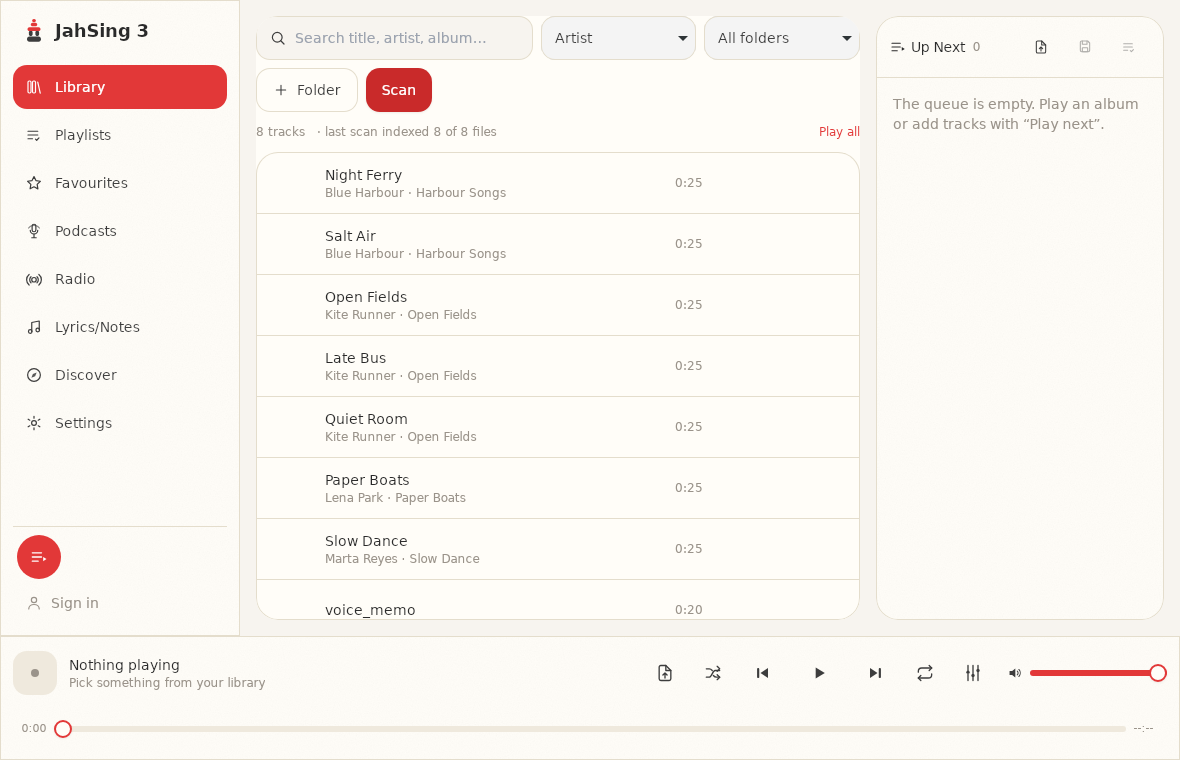
Curious about the rest of the story? Read About & Roadmap, or head to Downloads to try it.
Sources: Tales in Tech History: Winamp (Silicon UK); Rio PMP300 (Wikipedia); 11 Facts About Napster (Mental Floss); Apple Lossless Audio Codec (Wikipedia); JahSing About & Roadmap.