Why a Java MP3 Player Was a Big Idea in 2000
In the year 2000, playing music on your computer meant one of a few things. You might use Winamp, which was small and fast. You might use the player that came with Windows. Or you might try one of the dozens of free programs that popped up around the same time. Against that crowd, JahSing 1 did something odd: it was written entirely in Java. The project describes it as “the first ever 100% Java-based MP3 player and playlist manager.” That is the project’s own description and we have no independent way to check the “first ever” part, but the idea of building an MP3 player in Java at that time is worth exploring.
What was special about Java?
Java was created in the mid 1990s with a simple promise that its makers summed up as “write once, run anywhere.” The idea was that a programmer could write a program one time, and it would work on Windows, Macs and other systems, as long as each computer had Java installed. For a person writing a hobby project, that was very attractive. You did not need to learn a separate toolset for every kind of computer.
There was a catch. Java programs ran inside a kind of protective bubble, and that bubble sat between the program and the computer’s sound hardware. Programs that played audio needed extra help. In Java’s case, that help came mainly from the Java Media Framework, a package from Sun Microsystems that handled sound and video. Version 1.0 appeared in 1997, and version 2.0 came out in 1999, adding things like streaming and plug-in codecs.
Why MP3 mattered so much then
MP3 is a way of shrinking music files by throwing away details that most people cannot hear. A song that takes about 40 megabytes on a CD can shrink to around 4 megabytes as a decent-quality MP3. In the late 1990s, with small hard drives and slow dial-up connections, that was a huge deal. It meant you could keep hundreds of songs on your computer and even trade them online. The format was published as part of an international standard (called MPEG-1 Audio Layer III) in 1993, and by 2000 it was everywhere.
Every program that wanted to play MP3s had to include something that could “decode” them, meaning turn the shrunken data back into sound. In a Java program, that job was done by software written in Java too. It was slower than native code, so computers of the time had to work hard to keep up. Getting smooth playback out of a Java decoder on a typical home computer in 2000 was a real engineering effort.
The playlist part
JahSing’s roots were in playlists. The earlier program, Jahsee, was a playlist manager. JahSing 1 combined that with a player. It is easy to forget how new this combination was. Many people at the time juggled several programs: one to rip their CDs, one to play the files, and one to organize the results. A single window that handled the playing and the organizing was a relief.
What happened to the Java media tools
This is where the story takes a turn. The Java Media Framework got a lot of attention early on, but Sun made less and less of it. The MP3 decoder that came with version 2.0 was removed in 2002, and the last official release, 2.1.1e, was published on May 23, 2003. After that there were no further official updates. Programs that depended on it could keep working for a while, but they were building on a foundation that nobody maintained.
JahSing 2 was affected by this in the long run. The project’s own migration notes say that none of the media pieces JahSing 2 depended on survive on a current version of Java. That is the main reason JahSing 3 was rebuilt from the ground up rather than updated.
Was it worth doing in Java?
For the user, the answer was mostly yes. A Java player could run on more than one operating system, which was a rare feature among music programs of that period. It also made the project easy to share and to keep going over many years. JahSing’s run from 2000 to 2020, across two major versions, suggests the approach had some staying power.
For the developers, the trade-off was constant. Java gave them reach and a friendly language, and in return they had to depend on tools that eventually stopped being updated. That is a common story in software: a choice that makes sense at the start can become a burden years later.
What JahSing 3 does differently
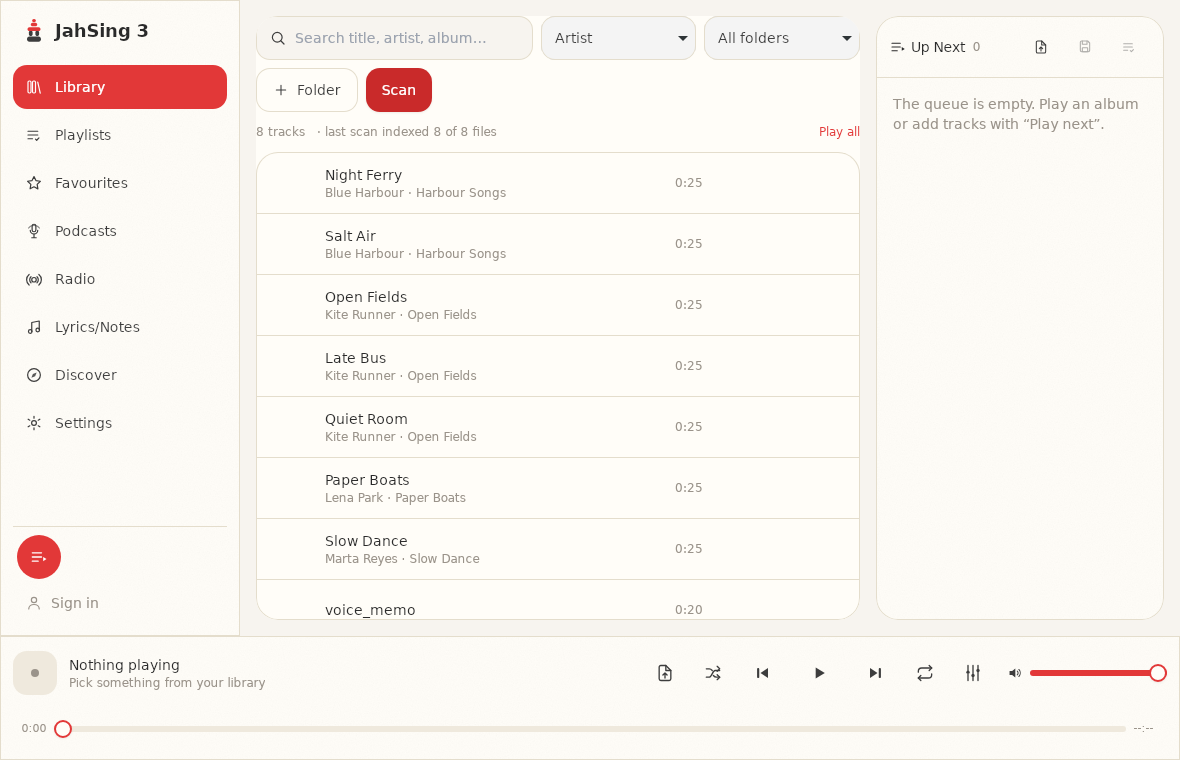
JahSing 3 was built with tools that are actively maintained today, and its playback engine is the same on every device. You can see what a modern, local music library looks like below. Everything in the picture is sample data created for this article.
If you want to try it, the Downloads page has the current version for Windows, macOS, Linux and Android. You can read the full timeline in About & Roadmap.
Sources: JahSing About & Roadmap; Java Media Framework on Wikipedia (release dates); Library of Congress format description for MPEG-1 Audio Layer III (1993 standard).