From Jahsee to JahSing 3: Nearly 30 Years of a Java Music Player
Most music programs from the late 1990s are long gone. JahSing is still here. It started in 1998, and in 2026 it came back as a completely rebuilt player called JahSing 3. This is the story of how it got from there to here, told in plain terms, with a look at what stayed the same and what changed.
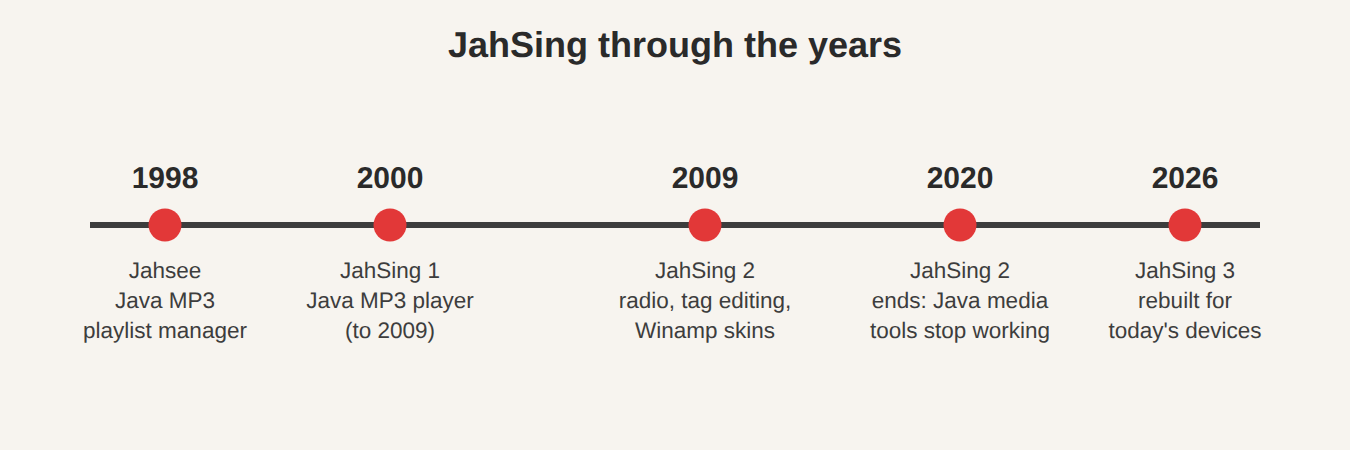
1998: Jahsee, a playlist manager
The first version was called Jahsee. It was a small program written in Java, a programming language that was popular in the late 1990s because the same program could run on different kinds of computers. Jahsee did one job: it helped you keep your MP3 files in playlists. At the time, a typical computer owner had a few hundred songs saved on a hard drive, often ripped from their own CDs, and the main problem was keeping them organized.
That is a useful way to think about the whole project. JahSing has always been about looking after a personal collection of music files on your own computer.
2000 to 2009: JahSing 1
In 2000, the program grew into JahSing 1. Although not externally validated, the project’s owner believes it to be “the first ever 100% Java-based MP3 player and playlist manager.” We can definitely say that Java was mainly known for other kinds of software at the time, so a music player written entirely using that language was a unique idea.
JahSing 1 played MP3 files itself and kept playlists in the same window, so there was one program for both jobs. It stayed around for nine years.
2009 to 2020: JahSing 2
JahSing 2 arrived in 2009 and was a bigger step. It added internet radio, tag editing (changing the title, artist and album stored inside a song file), and support for Winamp skins, the downloadable “outfits” that changed how a player looked. It was built with Java Swing, which is Java’s toolkit for drawing windows and buttons.
For about a decade this was the version people used. It was a desktop program, and it did what a player needed to do in that era.
Why JahSing 2 had to end
Here is the part that surprises people: JahSing 2 did not end because people stopped liking it. It ended because the tools underneath it stopped working. Java programs of that period often relied on an add-on called the Java Media Framework to play sound and video. Sun Microsystems released the last version of that framework in 2003, and it was never meaningfully updated afterward. Over the years, the parts that JahSing 2 depended on no longer worked on current computers.
You can only patch a building like that for so long. Eventually, the team behind JahSing decided not to try to port the old code, and instead rebuilt every part for modern systems. JahSing 2 was roughly 46,000 lines of Java code, and almost none of the supporting media components survive on a current version of Java.
2026: JahSing 3
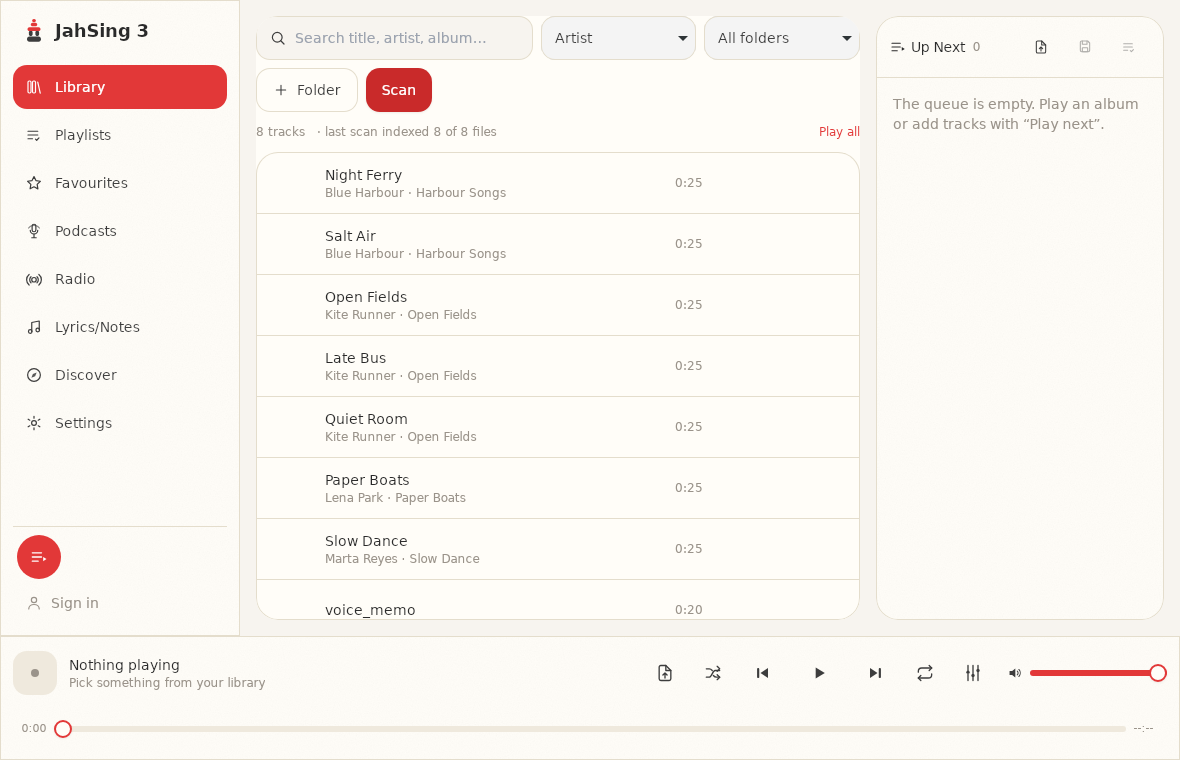
JahSing 3 is the result of that rebuild. It runs on Windows, macOS and Linux, and also on iPhone and Android. Under the hood it is a different machine: a new playback engine written to run quickly and the same way on every device, and a new screen design.
What you get today, according to the Features page, includes:
- Playback of MP3, FLAC, Ogg, WAV, AAC and ALAC files, plus old-style tracker modules.
- A library you build from folders on your computer, with search, playlists and favorites.
- Internet radio and podcasts.
- Time-synced lyrics, when they can be found.
- A tag editor for fixing song details and cover art.
- A 10-band equalizer and a stereo balance control.
- A pop-out video window.
- Classic Winamp skin support.
What carried over, and what did not
A lot of the spirit carried over. Internet radio, tag editing and Winamp skins were all JahSing 2 features, and they are all back. Some old features were left behind on purpose. JahSing 2 also had tools for capturing from webcams and broadcasting over a network, which depended on the same abandoned Java framework. Those were dropped, and the project says cross-device listening will be rebuilt more cleanly later.
One thing that changed in the way the program thinks: JahSing 2 re-read the tags in your files whenever it needed them. JahSing 3 reads them once, stores the results in a small database on your computer, and then searches that database. For a big collection, that should make searching quicker.
What is next
The current release (Phase 1), is a complete player that works on your own machine. A second phase is planned and will include optional user accounts that enable paid Pro advanced functions, such as a music virtualizer, remote music play, syncing music progress across devices, sending music to speakers, and listening together. None of those are required to use JahSing 3, so the player you download today (for free) will always work.
Want to try it?
You can download JahSing 3 from the Downloads page. It is free to use for local music, with some advanced features offered through a subscription. If you used JahSing 2 years ago, it should feel familiar, just faster and with a fresher look.
Sources: JahSing About & Roadmap, JahSing Features, and the Java Media Framework article on Wikipedia for the 2003 final release.