Why JahSing 2 Had to Be Rebuilt From Scratch
When a favorite program stops working, people often assume the programmers lost interest. The truth is usually less dramatic. Programs are built out of other people’s parts, and those parts change, move or vanish. That is what happened to JahSing 2. This article walks through what broke, in everyday terms, and what JahSing 3 uses instead.
A program is a stack of borrowed parts
Think of a music player as a meal cooked from ingredients you did not grow yourself. The player’s code is the recipe, but the sound decoding, the song labels, the lyrics lookup and the album covers all come from somewhere else. If a supplier closes down, the recipe still exists, but the dish cannot be made the same way.
JahSing 2 was written in Java and first released in 2009. By the end of its life in 2020 several of its suppliers had closed or stopped being maintained. JahSing 2 was roughly 46,000 lines of code, and it’s fair to say that none of its media pieces survive on a current version of Java. Here are the main ones.
1. Sound playback
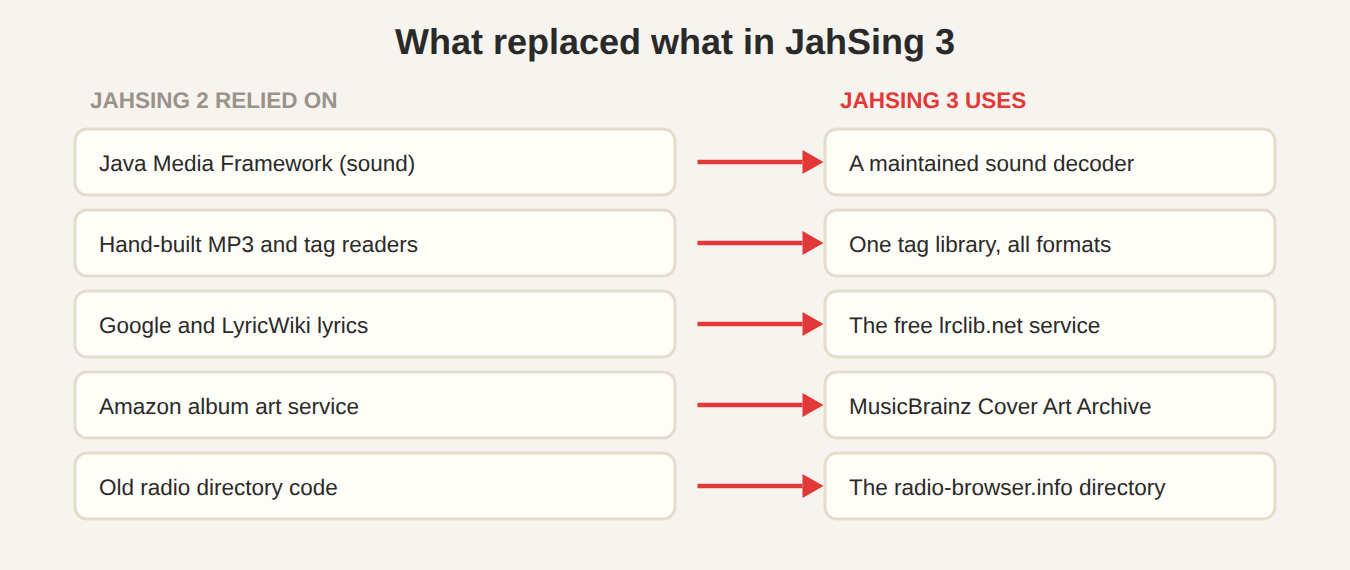
JahSing 2 used the Java Media Framework, a package from Sun Microsystems that handled audio and video for Java programs. The framework’s last official release was in May 2003, and the history of the framework shows that Sun quietly stopped working on it after that. It was never updated for the way modern computers handle sound and video, and it does not work on current versions of Java in the way it once did.
JahSing 3 replaced this with a modern sound decoder that is actively maintained. The same engine runs on desktop and on phones, which is something the old approach could never do.
2. Song labels (tags)
Inside most music files is a small label that stores the title, artist, album and cover art. Different file types store this label in different ways. JahSing 2 had a collection of hand-written pieces for reading and writing each style. JahSing 3 swaps all of that for a single maintained library that handles the common styles: ID3 labels in MP3 files, Vorbis comments in FLAC and Ogg files, and the labels in M4A files. The result is simpler, and one place has to be kept up to date instead of many.
3. Lyrics
JahSing 2 found song lyrics by looking them up on websites such as Google and LyricWiki. This was always a fragile approach, because it meant reading the text of someone else’s web page, and those pages change or disappear. Those sources are long gone. JahSing 3 uses LRCLIB, a free lyrics service that does not require a sign-up and offers lyrics that move in time with the music when they are available.
4. Album covers
JahSing 2 fetched missing album art from an Amazon web service. That service was shut down years ago, so the feature simply stopped working. The project’s migration notes name the Cover Art Archive as the replacement. It is a community-run collection of cover images connected to the MusicBrainz music database, so it does not depend on one company’s shop.
5. Internet radio
JahSing 2 played internet radio using its own code for handling streams and the extra song information that stations send along. JahSing 3 searches the public radio-browser.info directory and plays stations through the same engine as your own files.
Why not just patch the old program?
This was a real quandary. The first option was to try and keep JahSing 2 limping along by finding replacements for each broken part one by one, or alternatively, go in a new direction using a modern foundation. Choosing the second option, the team chose to start over, and build each feature fresh instead of porting the old code line by line. There were a few reasons this made sense:
- The foundation was the problem. Replacing parts inside a structure built around an abandoned framework would mean changing nearly everything anyway.
- Phones. JahSing 3 runs on iPhone and Android, which the old Java approach could not do.
- Speed. A newer engine is better suited to large libraries and to playing music smoothly.
- Future repairs. A smaller set of well-maintained parts is easier to keep working over the next ten years.
What got dropped
Not everything made the trip. JahSing 2 had a set of tools for capturing video from cameras and broadcasting over networks, built on the same Java framework. The project judged those tools to be niche and tied to dead technology, and left them behind. The same goes for the many look-and-feel add-ons that gave JahSing 2 different window styles. JahSing 3 has one consistent design instead. Features such as listening together across devices are planned to come back in a later phase, built on a cleaner base.
What you can see for yourself
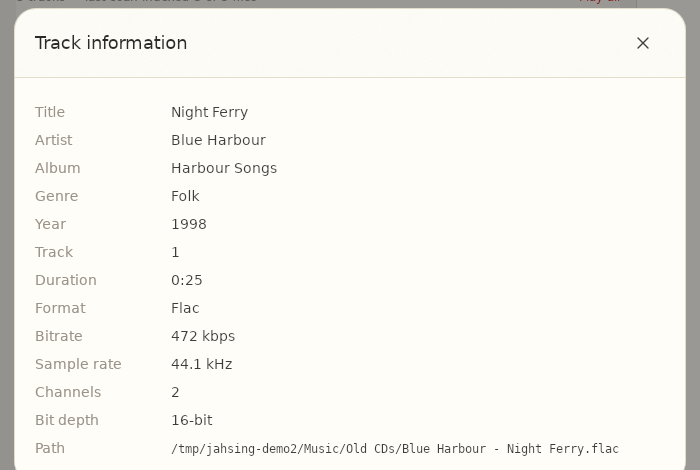
One small example of the new engine at work: select a song in JahSing 3, add it to the queue and choose Information. The window reports the song’s format, bitrate, sample rate and more. Here is a FLAC file from a set of sample songs made for this article.
The lesson
Software ages in two ways. The first is that the code itself gets old. The second, which is often the bigger one, is that the world around it changes. JahSing 2 mostly met the second kind of aging. That is why JahSing 3 leans on parts that many other projects also use, so that when one needs a fix, many people are working on it at the same time.
You can try the result by visiting the Downloads page, or read the full history on the About & Roadmap page.
Sources: JahSing About & Roadmap; Java Media Framework on Wikipedia; LRCLIB; MusicBrainz Cover Art Archive; radio-browser.info.